"To be a leading liberal arts University in Asia for the world delivering academic excellence in a caring, creative and global culture."
- HKBU Vision Statement
"To deliver the best student experience by preparing students for cultural understanding, global collaboration, leadership, service and employment in an increasingly interdependent, intertwined world."
- A Core Objective of the HKBU Institutional Strategic Plan 2018-2028
Welcome to HKBU! We are thrilled to have you join our big family.
As a new student, you are bound to have questions. Our student orientation activities are designed with you in mind, helping you find answers to your questions, transition successfully to university study, and familiar yourself with our campus and EdTech resources.
Getting Ready for the New Semester
Digital learning and teaching are widely utilised in higher education. Our University is bringing a paradigm shift to the teaching curriculum and assessment. You are encouraged to use the following materials to learn effectively in an online or blended learning environment (e.g. flipped classroom).
Use of Moodle
You should watch the videos on how to access the study materials on Moodle. More video guides can be found on the Digital Learning & Teaching@HKBU website.
Use of Zoom
You should also learn how to attend online classes hosted by your teachers. A guide showing the basics of Zoom is available here.
University Life Orientation Workshop 2 (UOW2) - Insights into the 7 HKBU Graduate Attributes
For AY2026/27, the UOW2, part of the Academic Integrity and Ethics Awareness Programme (AIE-AP), will be conducted at the HKBU campus on 21 August 2026 (Friday) or 22 August 2026 (Saturday). Further details about your attendance will be sent to you via HKBU email.
Please check your newly registered HKBU email account regularly and stay tuned for any updates on the UOW2.
New Assessment
Assessment shall evaluate your subject knowledge and capabilities to apply a repertoire of knowledge and skills to solve real-world problems. In line with HKBU’s paradigm shift in curriculum and assessment, new forms of assessment throughout the learning process have been adopted in our courses. More details, including the assessment arrangements of your enrolled courses, will be provided by your teachers at the beginning of the semester.
7 HKBU Graduate Attributes for Undergraduate Students
“What do these have to do with me?”
Education at HKBU aims to unlock your potential and competencies in all aspects of whole person development. HKBU defines this educational philosophy through a spectrum of Graduate Attributes for you to develop:
Citizenship 公民
Be globally minded, ethically responsible and committed to sustainability.
具備全球思維,肩負道德責任,致力於可持續發展
Knowledge 知識
Be well-versed in disciplinary and transdisciplinary knowledge.
精通學科及跨學科知識
Learning 學習
Be reflective, inquisitive independent learners and problem-solvers with humanistic and technological perspectives.
善於反思、虛心、自主求學,以兼具人文和科技的視野解決問題
Creativity 創意
Be creative and entrepreneurial.
具創新和開拓精神
Communication 溝通
Communicate in multiple languages and modalities effectively and empathetically.
富有同理心,有效地以多種語言及方式溝通
Teamwork 群體
Collaborate and serve with and for diverse groups of people.
團隊協作,服務多元社群
Well-being 康健
Be well physically, mentally and spiritually.
身心靈健康
(approved by the Senate for implementation with effect from Academic Year 2025/26)
Expectations of Employers from Today’s University Graduates
“Why are the HKBU Graduate Attributes important to me?”
Employers in Hong Kong have expressed their desired qualities/competencies in YOU. These desired qualities/competencies comprise the 7 HKBU Graduate Attributes (GAs).
Global mindset, ethical responsibility, cultural sensitivity.
Strong academic training, industry expertise, and relevant knowledge.
Reflective, independent, adaptable problem-solvers with the use of technology.
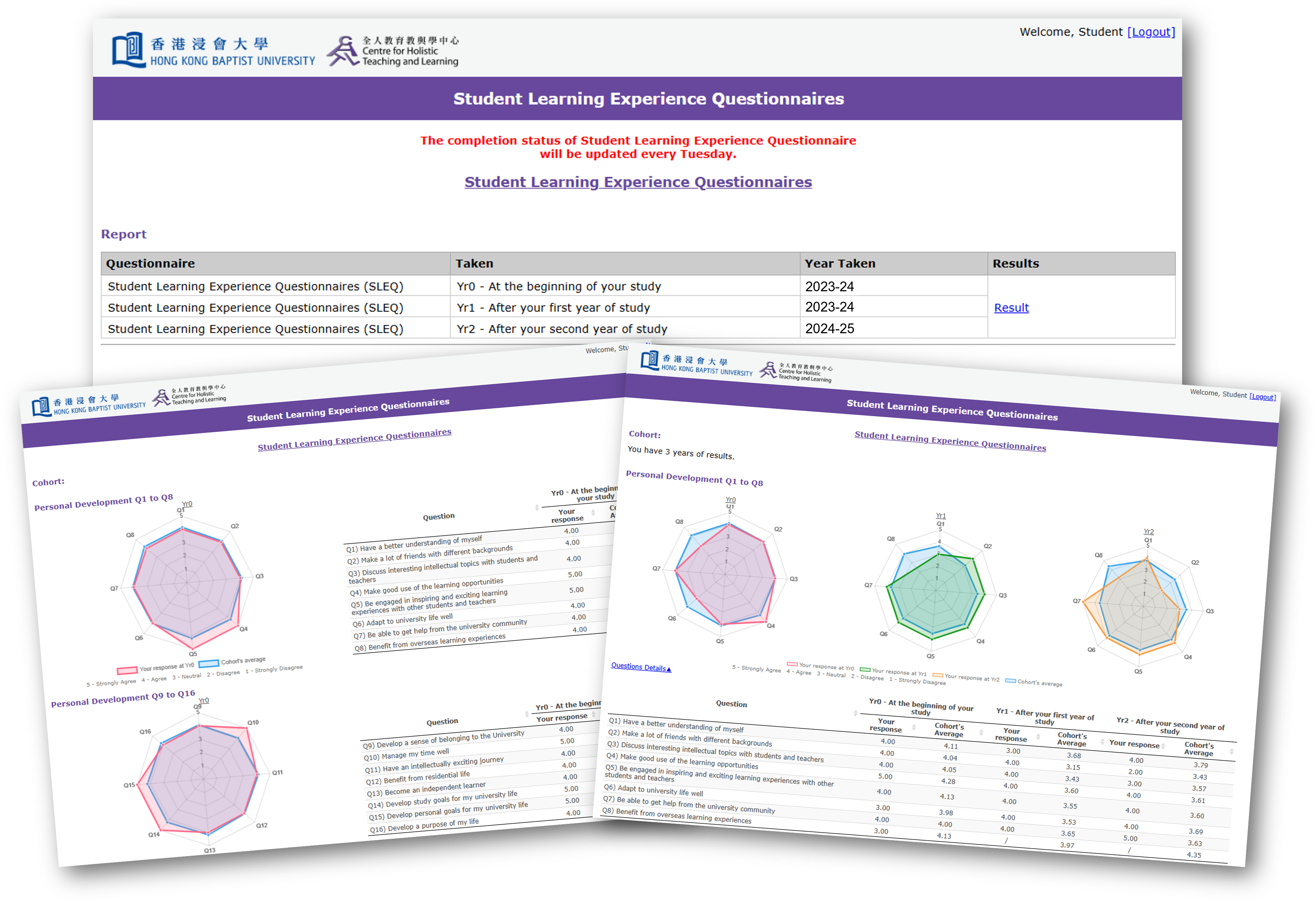
As a student, it would be useful for YOU to think of learning as an ongoing process in which your expectations and actual experience can fuel your development in your study and life at HKBU. The Student Learning Experience Questionnaire (SLEQ) assists YOU as well as the University in understanding your study and university life experiences and your development in the University’s Graduate Attributes. SLEQ will be conducted at different points along the timeline of your stay at HKBU:
Year 0 Student Learning Experience Questionnaire
Before the commencement of your study programme
Year 1 Student Learning Experience Questionnaire
At the end of your first year of study
Year 2 Student Learning Experience Questionnaire
At the end of your second year of study
Year Final Student Learning Experience Questionnaire
During the final year of your study, before graduation
SLEQ will help you reflect on your expectations and experience. More importantly, your SLEQ responses will provide important data for the University to enhance its learning and teaching initiatives continuously. Timely support in both academic and personal growth could also be rendered to YOU if necessary.
To help you trace and track your completion in the exercise, after completing each SLEQ, you will receive a report on your progress compared to the previous one, as well as your standing against that of your fellow students. The report will be a useful snapshot of your education at HKBU. You can view your results of the SLEQ here.
(B) Academic Integrity and Ethics Awareness Programme (AIE-AP)
HKBU’s Policy on Academic Integrity
University education must emphasise developing your academic integrity and ethics, which are essential for your personal growth and future professional careers.
Academic integrity is a cornerstone of HKBU’s Whole Person Education ethos. As one of HKBU’s University Life Programme requirements, the Academic Integrity and Ethics Awareness Programme (AIE-AP) is specifically designed to reinforce and stress the obligations of all students to uphold the highest standard of academic integrity at HKBU.
There are two major components in the AIE-AP, conducted at the start of your study at HKBU to signify that you are expected to behave ethically with integrity not just at HKBU but also for the rest of your life as you become a life-long member of the HKBU community. The two major components are:
All undergraduate students are expected to complete the AIE-AP as soon as practicable as they are essential and helpful for studying at HKBU.
Academic Integrity Online Tutorial (AIOT)
HKBU offers AIOT as an introduction to promote academic integrity by increasing your awareness of the issues involved. Using pertinent cases as examples, each of the six modules in AIOT provides information and strategies that can be applied to avoid committing academic misconduct unintentionally.
If you fail to complete the AIOT before the end of your 2nd semester, you may be barred from accessing the course grades or enrolling for courses.
Please refer to the deadline specified in your University Life Programme Attendance Record in BUniport.
More details of the step-by-step guide to the Academic Integrity Online Tutorial are available here.
Outcomes-Based Teaching and Learning (OBTL) at HKBU
“What can I achieve after taking the courses?”
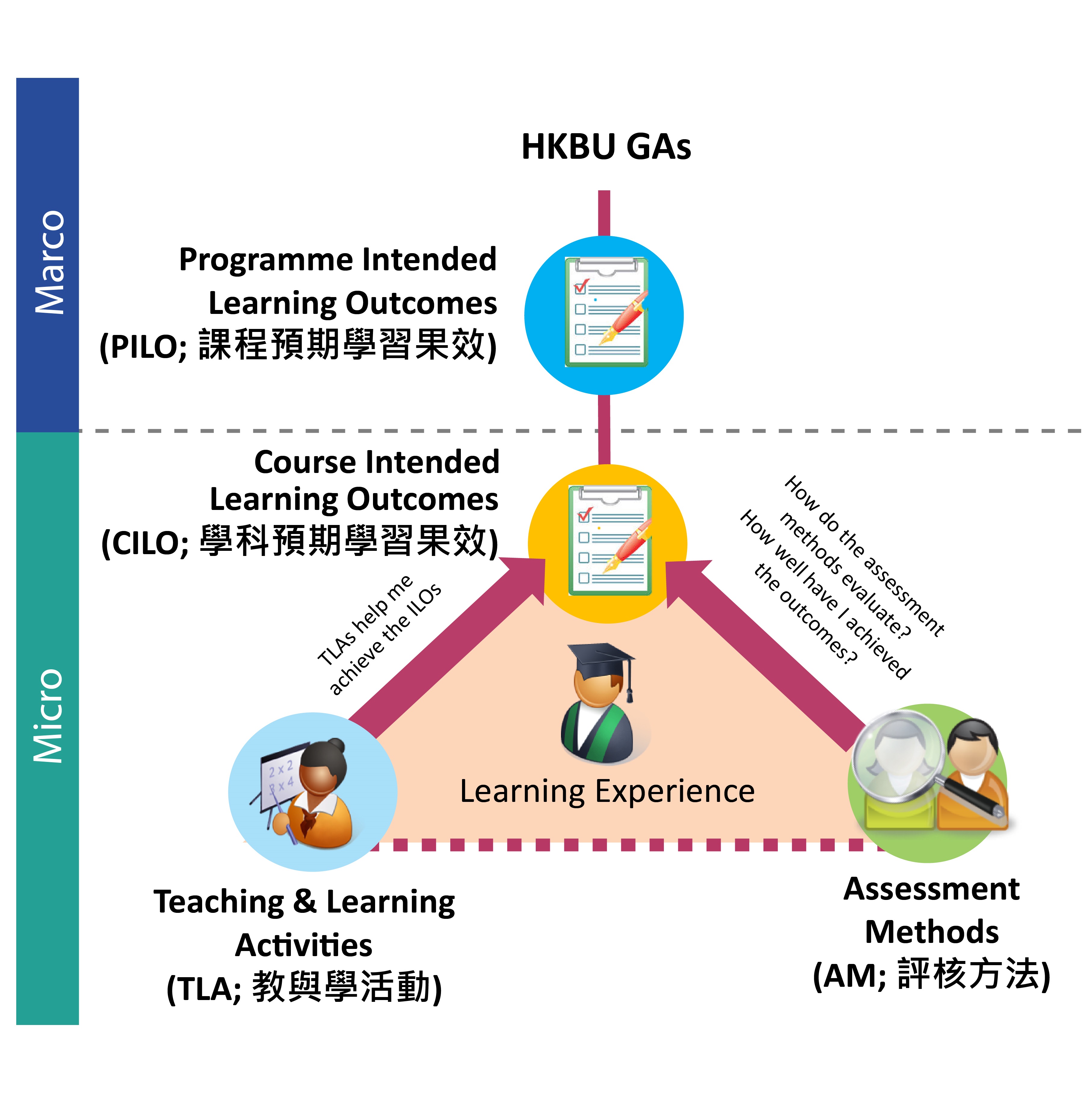
Outcomes-Based Teaching and Learning (OBTL) is primarily concerned with focusing on what you are actually learning and how well you have learnt it. OBTL is a pedagogical process which, as its name suggests, focuses on the achievement of certain specified abilities.
Micro Level:
The course Intended Learning Outcomes (CILOs), the Teaching and Learning Activities (TLAs), and the Assessment Methods (AMs) are constructively aligned at the course level.
Macro Level:
Courses in any given programme at HKBU are further aligned to their respective Programme Intended Learning Outcomes (PILOs), which will facilitate the students’ attainment of the HKBU Graduate Attributes (GAs).
Criterion-Referenced Assessment (CRA) is adopted for effective OBTL implementation. Here are two important concepts of CRA:
Use of objective criteria.
No pre-set distribution of grades.
The document, Policy for the Assessment of Student Learning, is available on the BUniport. There are some points you should not miss:
Normally, you will receive marked or graded assessments with appropriate feedback no later than three weeks after the submission deadline.
Assessment rubrics will be used to assess your work.
Digital Learning & Teaching@HKBU
“What does this have to do with me?”
HKBU provides different technology platforms, including Moodle and Zoom, to support digital learning and teaching. With a suite of tools adopted by experienced faculty members, HKBU strives to deliver interactive, convenient and engaging learning experience for you.
learn more about the available digital learning & teaching tools;
find support and useful resources, such as self-help guides; and
access the learning management system directly.
“What can I do with these digital learning & teaching tools?”
Learning Management System - Moodle
share files or links with other students and the instructors, e.g. through discussion boards;
submit assignments;
access course content outside classrooms.
eSurvey Tool - Qualtrics
build questionnaire.
Personal Response System (PRS) - Mentimeter
set up polling, quizzes, and collect lively feedback from the audience.
Anti-plagiarism Tool - Turnitin
check your assignment against plagiarism.
Generative AI Principles & Advisory Guidelines
HKBU has established the Principles for the Use of Generative AI Tools in Teaching and Learning, and Assessment to support the responsible use of generative AI. The use of AI is guided by four core principles:
AI-Empowering: to embrace generative AI and empower students and instructors to realise the potential of generative AI tools as part of the University’s knowledge creation and teaching and learning ecosystem.
AI-Critical: to encourage healthy, informed scepticism of generative AI and develop students’ and instructors’ critical thinking and awareness of the strengths, drawbacks and limitations of generative AI tools.
AI-Ethical: to maintain academic integrity, transparency and the ethical use of generative AI tools.
Build and sustain human uniqueness: to recognise the importance of students and instructors as unique individuals with lived experiences, knowledge, skills and attributes.
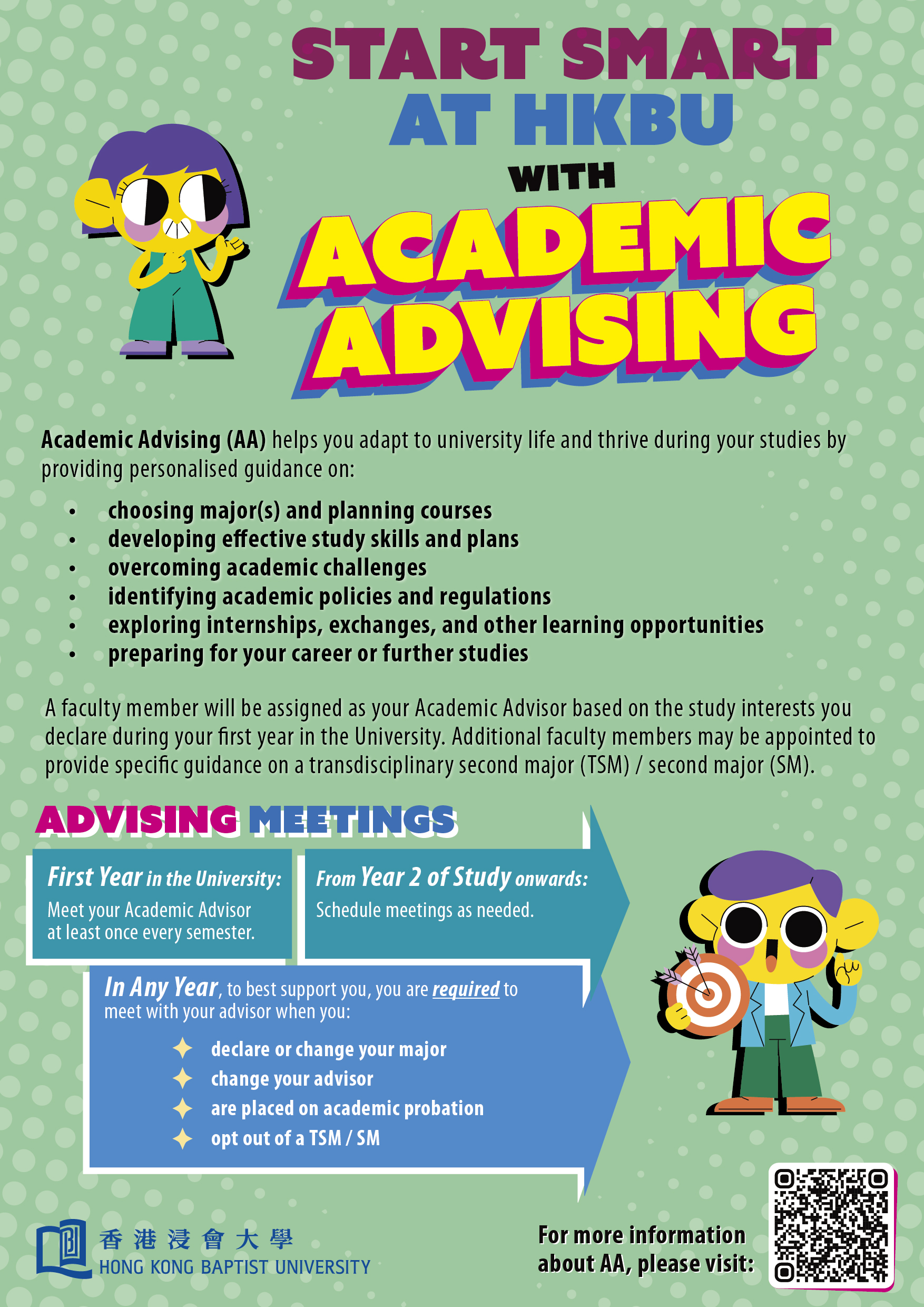
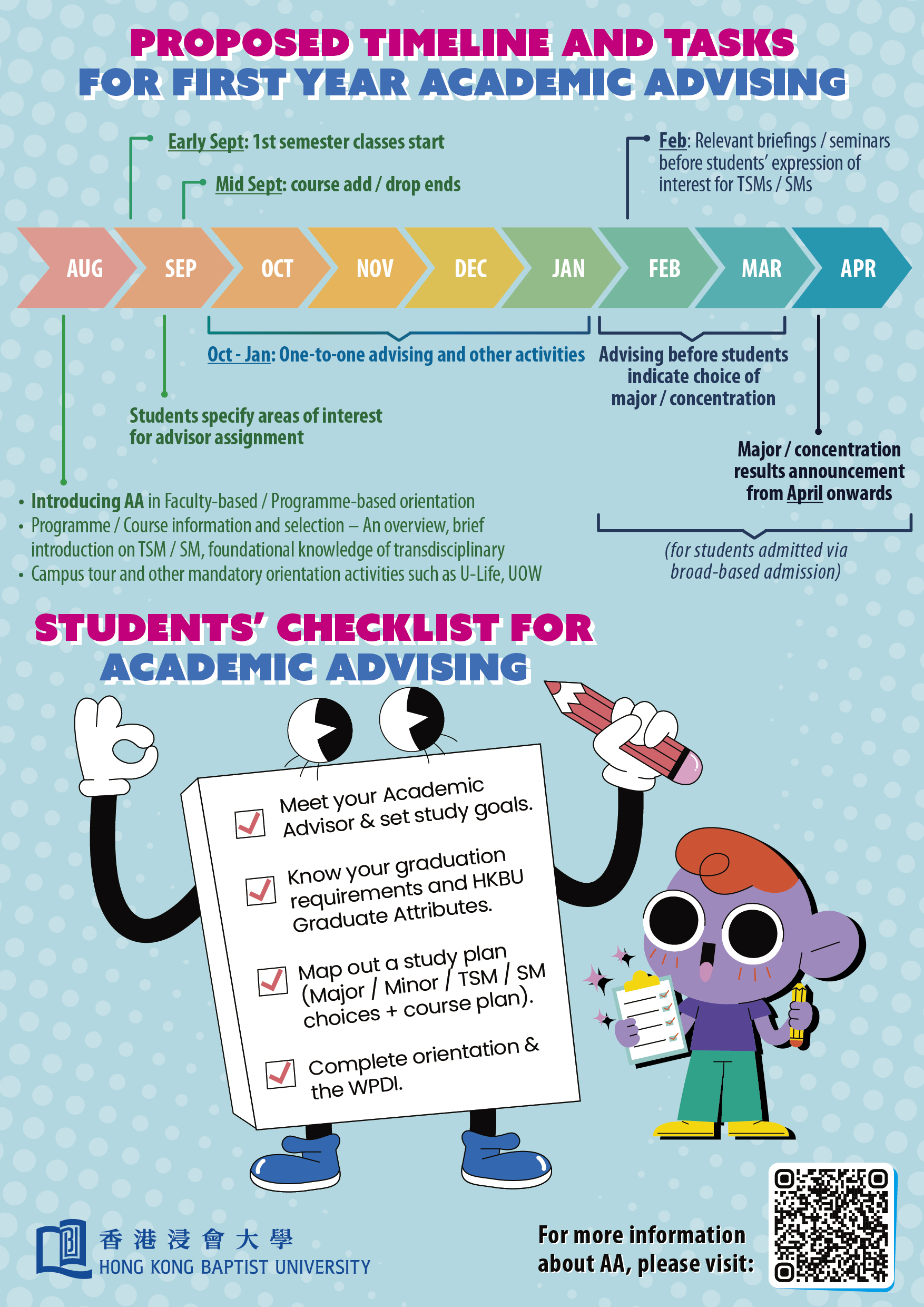
Academic Advising (AA) is here to help you adapt to university life. Your academic advisor offers support as you choose your study majors, register for courses, develop study plans to meet graduation requirements, and learn about university policies and regulations, to name a few.
Beyond your classes, your advisor will introduce you to a variety of learning opportunities, like student exchange, internships, experiential learning, service-learning, and residential education. With such guidance, you will be able to set your personal and academic goals and work towards achieving them. AA is a key part of making sure you have the Best Student Experience during your time at HKBU.
AA continues throughout your university learning journey — not just in your first year. Your advisor will help you update your study plans, connect what you are learning to your future career or further study goals, and overcome any challenges you may face.
You will have regular opportunities to meet and communicate with your advisor through both formal consultation meetings and informal gatherings, either one-on-one or in groups.
"When should I Meet My Academic Advisor?"
In your first year in the University, you must meet with your academic advisor at least once every semester.
From Year 2 of study onwards, you are encouraged to meet your advisor whenever you need advice or want to discuss your progress.
You will also need to meet your advisor if you:
declare or change your major
change advisors
are placed on academic probation
opt out of a transdisciplinary second major (TSM) or second major (SM).
"What am I expected to do as an advisee?"
Take an active role in academic advising activities
Reach out to your advisor for advice
Attend scheduled meetings and comply to any agreed consultation times
Create your own study plan and keep track of your learning progress
Learn about academic policies and regulations as well as graduation and programme requirements
AA is designed to help you make the most of your university experience. Do not hesitate to ask questions and seek support whenever you need it!
The Centre for Holistic Teaching and Learning (CHTL) at Hong Kong Baptist University (HKBU) and all associated marks and logos are trademarks, registered trademarks and service marks of the HKBU.