"To be a leading liberal arts University in Asia for the world delivering academic excellence in a caring, creative and global culture."
- HKBU Vision Statement
"To deliver the best student experience by preparing students for cultural understanding, global collaboration, leadership, service and employment in an increasingly interdependent, intertwined world."
- A Core Objective of the HKBU Institutional Strategic Plan 2018-2028
Our New Staff Induction, the EdTech Kickoff Series, and other related orientation activities are informative, interactive, and social activities planned to help new staff embrace our University. These events help to get to know other new colleagues and the existing faculty and staff of HKBU, creating interaction and engagement.
Education at HKBU aims to unlock students’ potential and competencies in all aspects of whole person development. HKBU defines this educational philosophy through a spectrum of Graduate Attributes for students to develop.
Graduate Attributes for Undergraduates
On graduation, HKBU Undergraduate graduates should:
Citizenship 公民
Be globally minded, ethically responsible and committed to sustainability.
具備全球思維,肩負道德責任,致力於可持續發展
Knowledge 知識
Be well-versed in disciplinary and transdisciplinary knowledge.
精通學科及跨學科知識
Learning 學習
Be reflective, inquisitive independent learners and problem-solvers with humanistic and technological perspectives.
善於反思、虛心、自主求學,以兼具人文和科技的視野解決問題
Creativity 創意
Be creative and entrepreneurial.
具創新和開拓精神
Communication 溝通
Communicate in multiple languages and modalities effectively and empathetically.
富有同理心,有效地以多種語言及方式溝通
Teamwork 群體
Collaborate and serve with and for diverse groups of people.
團隊協作,服務多元社群
Well-being 康健
Be well physically, mentally and spiritually.
身心靈健康
(approved by the Senate for implementation with effect from Academic Year 2025/26)
Graduate Attributes for Postgraduates
HKBU Taught Postgraduate Graduates
On graduation, HKBU Taught Postgraduate graduates should:
Citizenship 公民
Be globally minded, ethically responsible and committed to sustainability. 具備全球思維,肩負道德責任,致力於可持續發展。
Knowledge 知識
Be well-versed in the specialised field of studies, and apply such knowledge professionally and ethically. 精通專業領域知識,並以專業操守應用所學。
Learning 學習
Be reflective, inquisitive independent learners and problem-solvers with humanistic and technological perspectives in the specialised field of studies. 在專業領域上善於反思、虛心、自主求學,以兼具人文和科技的視野解決問題。
Creativity 創意
Be creative and entrepreneurial. 具創新和開拓精神。
Communication 溝通
Communicate in different modalities effectively and empathetically. 富有同理心,有效地以不同方式溝通。
Teamwork 群體
Collaborate for the benefit of diverse groups of people. 團隊協作,惠及多元社群。
Well-being 康健
Be well physically, mentally and spiritually. 身心靈健康。
(approved by the Senate for implementation with effect from Academic Year 2026/27)
HKBU Research Postgraduate Graduates
On graduation, HKBU Research Postgraduate graduates should:
Citizenship 公民
Be globally minded, locally engaged, ethically responsible, and committed to integrity and sustainability. 具備全球思維,參與本地事務,肩負道德責任,恪守誠信,致力於可持續發展。
Knowledge 知識
Be masters and creators of scholarly and transdisciplinary knowledge at the forefront of their specialised field, who are prepared to apply this knowledge for social impact. 精通並開創專業領域前沿之學科與跨學科知識,能夠學以致用,貢獻社會。
Learning 學習
Be reflective, inquisitive and independent learners who seek to pursue significant questions and extend the boundary of knowledge in their field through systematic and critical inquiry. 成為善於反思、勤於探索的獨立學習者,透過系統且批判性的探究,在專業領域鑽研重要問題、拓展知識界限。
Creativity 創意
Be creative and entrepreneurial, critically re-evaluating conventional knowledge and pursuing original research insights with intellectual courage. 具備創新與開拓精神,能以批判態度審視既有知識,敢於追求原創性的研究洞見。
Communication 溝通
Communicate knowledge and research ideas persuasively, effectively, and empathetically to both specialist and non-specialist audiences in appropriate modalities. 能夠通過恰當的溝通方式,有效、具說服力、富同理心地向專業受眾及公眾傳達知識與研究構想。
Teamwork 群體
Collaborate and establish purposeful partnerships in diverse communities to advance shared knowledge and goals. 在多元社群中協作,建立目標明確的夥伴關係,促進知識交流,實現共同願景。
Well-being 康健
Be resilient and well physically, mentally and spiritually. 保持堅韌,身心靈健康。
(approved by the Senate for implementation with effect from Academic Year 2026/27)
Outcomes-Based Teaching and Learning (OBTL)@HKBU
“What can students achieve after taking my course?”
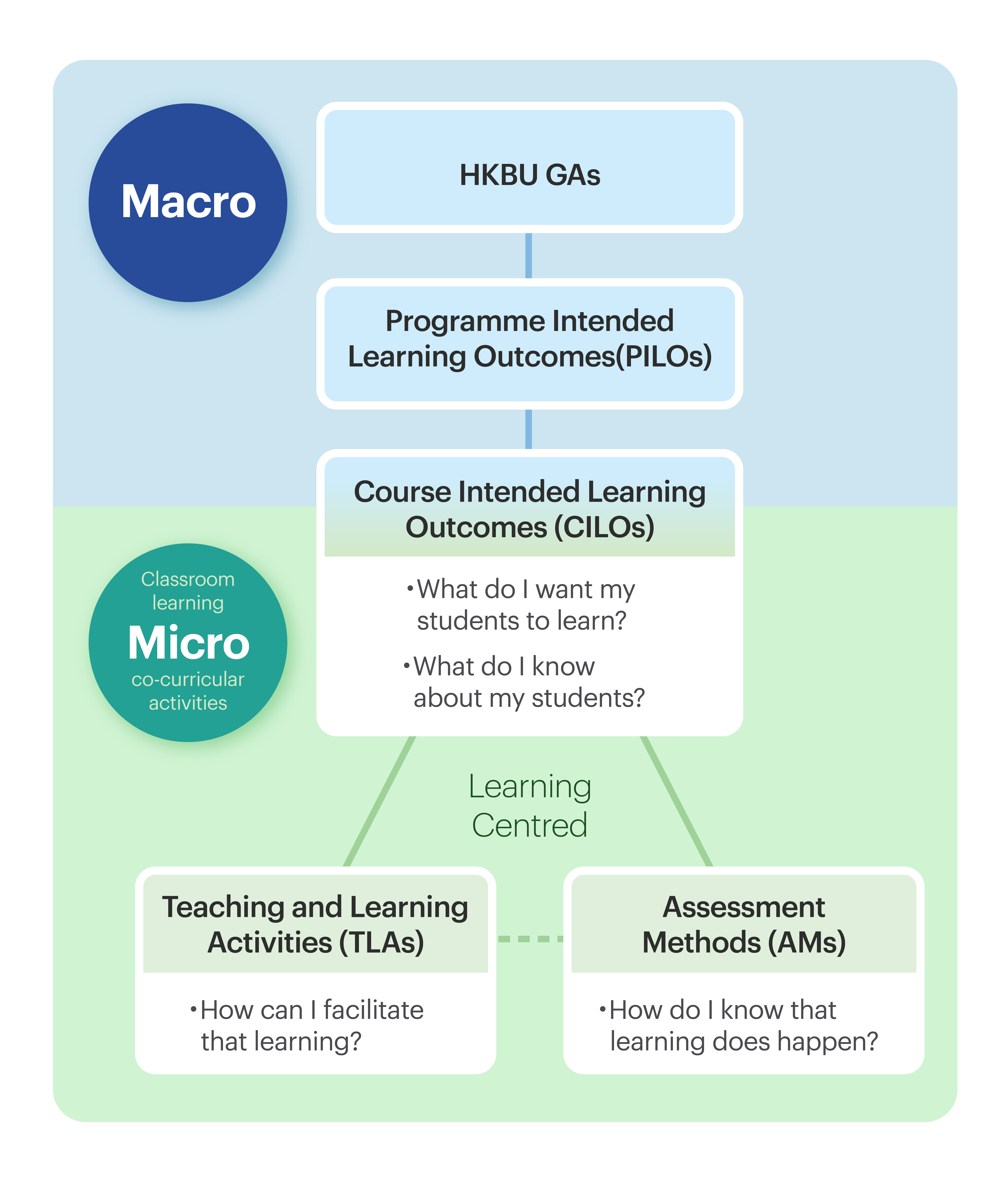
The principle of Outcomes-Based Teaching and Learning (OBTL) is based on constructive alignment, which presumes that all components in teaching, especially the Assessment Methods (AMs) and the Teaching and Learning Activities (TLAs), are aligned to the Course Intended Learning Outcomes (CILOs) to help students achieve them.
To implement OBTL effectively, HKBU recognises that a full commitment to learning and teaching must include strategies of assessment and documentation that focus on the content and learning progress of our students. One of the strategies is to use Criterion-Referenced Assessment (CRA) to assess students’ progress and final attainment in achieving learning outcomes against a set of objective criteria.
For more information about the OBTL concept, learning taxonomies, and OBTL requirements for programme accreditation, please visit here.
Checklist for the First Day of Class
The first day of class is a valuable opportunity to introduce yourself as a scholar and educator. It sets the tone for the semester, outlines your teaching practices, and clarifies your expectations for student involvement.
To facilitate students’ learning, the practice of video-recording and archiving lectures will continue in the coming academic year. Meanwhile, instructors also need to get ready and prepared for the changes in the teaching mode.
To ensure a smooth start, please consider the following checklist:
To-Do Checklist for Your First Class
Preparations Before Class
Class Logistics
Checked class time and classroom location.
Downloaded the up-to-date class roster.
Course Materials
Uploaded course materials to the Moodle course room for student access.
Finalised the course syllabus and grading policy, ensuring alignment with intended learning outcomes and assessment methods.
Student Engagement
Ice Breakers and Expectations
Incorporated icebreaker activities into the first week of the course.
Confirmed methods for gathering students’ expectations, questions, and concerns regarding the course.
Communication and Announcements
Announcements
Prepared all necessary announcements, including those related to digital learning and teaching.
Met with teaching assistants to discuss roles and responsibilities.
Course Overview
Learning Outcomes
Prepared the intended learning outcomes, course outline, and description to share with students.
Technology Preparedness
Recording and Teaching Mode
Familiarised yourself with the video recording tools and archiving process for lectures.
Prepared for any changes in teaching mode, ensuring you are adaptable to different learning environments.
Digital Learning & Teaching@HKBU
Digital Learning & Teaching ecosystem
HKBU functions within a diverse environment of emerging educational technologies by establishing a supportive and flexible learning environment in which digital learning and teaching is an integrated, dynamic, and innovative element.
Strategy for Digital Learning and Teaching and Principles for the Use of Generative AI
The “Strategy for Digital Learning and Teaching” and the “Principles for the Use of Generative AI Tools in Teaching and Learning, and Assessment”, approved by the Senate in September 2022 and June 2023 respectively, are intended to provide colleagues with guidelines to facilitate the adoption of e-pedagogies in cultivating students to be active and self-directed learners / life-long learners, and enhancing their learning experience while still catering for diversity and flexibility in e-pedagogical practices.
More details of the two mentioned documents can be found on the BUniport, under the option of “U-Wide Policies & Info” >> “Policies & Guidelines” >> “Strategy for Digital Learning and Teaching” and “Principles for the Use of Generative AI Tools in Teaching and Learning, and Assessment”. Please note that a document of “Advisory Guidelines Pertaining to the Use of Generative AI Tools in Assessed Assignment Tasks (Summer 2025 Version)” can also be found under the same location.
“Internationalisation” via Developing Online Courses Initiatives with KEEP
With internationalisation as one of the priorities in the HKBU Institutional Strategic Plan 2018-2028, our University has been continuously promoting blended learning and establishing ties with renowned overseas universities.
With Small Private Online Courses (SPOCs) and other blended learning initiatives, our students can learn alongside their peers in other universities with different cultural backgrounds. The University has adopted KEEP (https://keep.edu.hk/) as our SPOCs platform. Teachers can also co-teach with overseas partners, opening up opportunities for joint programmes.
A Paradigm Shift in Assessment
Rethink/Redesign of student assessment methods with the aid of technology
With the advancement of technology, the use of online/mixed-mode activities such as virtual exchanges, online collaboration, online global discussion/forums, etc., has gained much popularity in higher education for enhancing face-to-face learning and teaching. Educators need to rethink and redesign assessment with the aid of technology for evaluating student learning performance and giving timely feedback to students during the learning process.
More information on how HKBU brings a paradigm shift to our curriculum and assessment by developing authentic assessment instruments and scoring rubrics could be found on our Advanced Study Institute (ASI) website. Good practices (feature stories) from HKBU are showcased at the website of renowned scholars, Kay Sambell and Sally Brown – Compendium 4: Thirteen authentic assessment examples from Hong Kong (9 examples from HKBU).
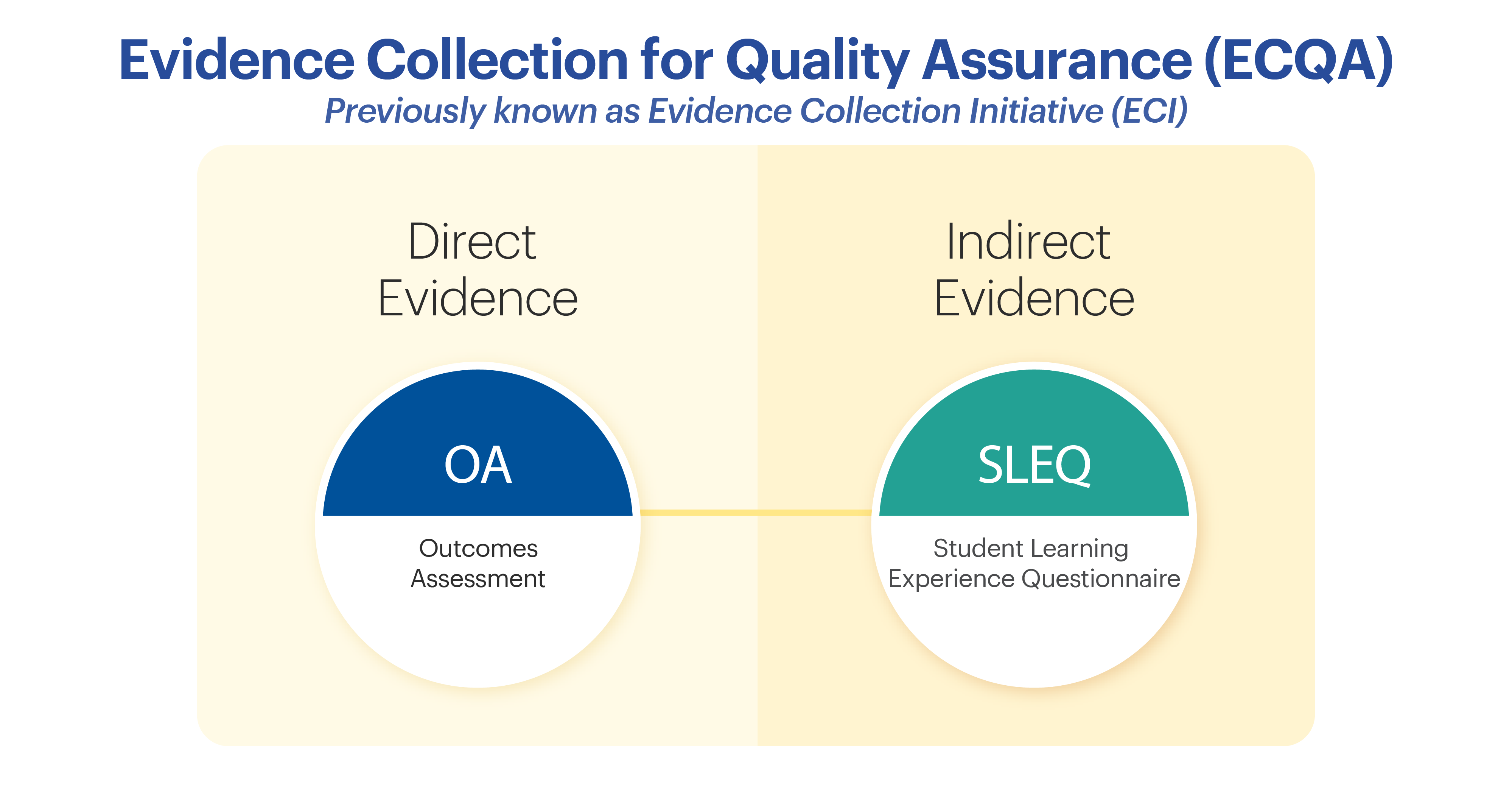
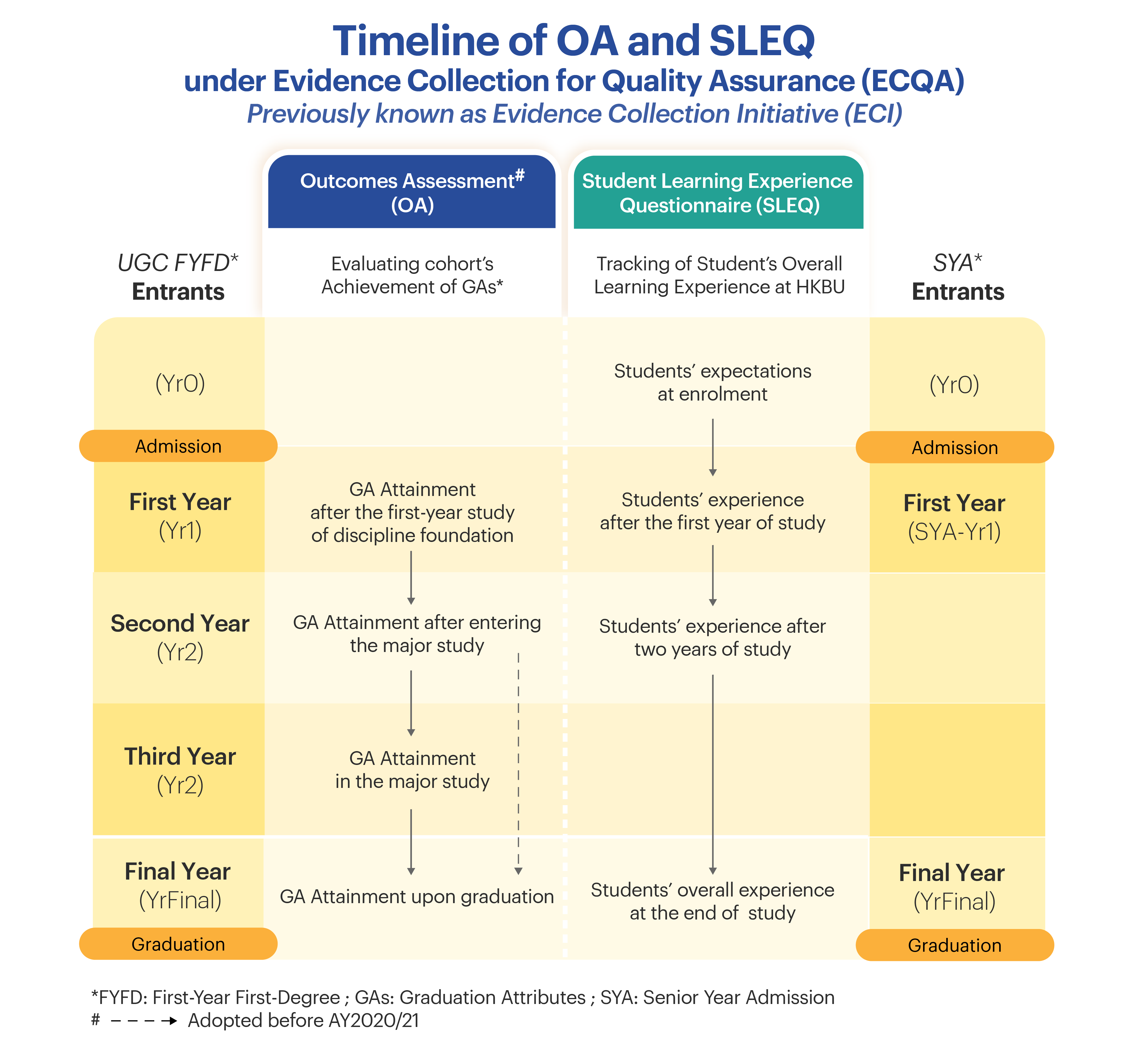
Operated by CHTL, the ECQA aims to assist the University in ascertaining how well students have achieved its Seven Graduate Attributes (GAs) through the collection of direct and indirect evidence. Figure 1 and Figure 2 illustrate its components and operation, respectively.
The aforesaid two types of evidence are triangulated to ascertain student achievement of GAs under the University’s learning environment of offering Best Student Experience (BSE), which, in turn, can help inform the University of quality assurance and enhancement in learning and teaching. Your encouragement to students to complete the Student Learning Experience Questionnaire (SLEQ) and collaboration for the data collection initiatives would be appreciated.
Figure 1. ECQA Components
Figure 2. ECQA Operation
Benefits of ECQA
Identify strengths and weaknesses in learning and teaching, and disseminate good practices
Generate and test credible evidence about the values of HKBU’s education
Provide recommendations to quality assurance and quality enhancement of learning and teaching
For details of SLEQ and OA, please click on them respectively.
Support for Learning and Teaching at HKBU
Teaching and Learning Experience Sharing (TALES) Seminar Series
The main goal of the TALES seminar series is to foster sharing and discussions about innovations and good practices in learning and teaching. The series offers valuable opportunities for colleagues at HKBU and invites international scholars to present their insights, showcase pedagogical innovations, and explore the effective use of technology in education, all while reflecting on their teaching practices.
Induction Programme for New Academic and Teaching Colleagues
The Induction Programme for new academic and teaching staff at HKBU aims to familiarise new colleagues with the University’s learning and teaching environment and culture. The Programme consists of two parts: (1) online initiatives (6 hours) and (2) Faculty Development Day (5 hours). While primarily for new staff, current colleagues are also welcome to join. Completing the Induction Programme, totalling 11 hours, is mandatory for new academic and teaching staff up to the rank of Assistant Professor.
1. Online Initiatives Available for New Academic and Teaching Staff (6 hours)
Deadline for completion: By the end of September 2026
(i) "Outcomes-based Teaching and Learning @HKBU" Online Course (4 hours)*
To better equip new teaching colleagues with the pedagogies adopted at the University, this 4-hour online course covers essential teaching theories, the OBTL approach, CRA, and more. Colleagues can access and complete the course content anytime and anywhere.
(ii) Induction Online Quiz (2 hours)
This online quiz is designed to enhance teachers’ knowledge and understanding of our University’s Institutional Strategic Plan 2018-2028 (ISP) and other T&L policies. It involves a series of questions designed to familiarise you with the ISP and help you design learning and assessment activities based on Teaching & Learning policies.
Please remember to check your HKBU email account for details on the arrangement for the Online Initiatives.
2. Faculty Development Day (5 hours)
New academic and teaching staff are expected to participate in the one-day, face-to-face Faculty Development Day to explore various Academic Support Units at HKBU and gather valuable insights from experienced colleagues. This event offers helpful resources, networking opportunities, and the chance to cultivate a positive learning and teaching environment while promoting professional growth.
* Mandatory workshop and online course for new academic/teaching colleagues up to the rank of Assistant Professor.
The EdTech Kick-off Series aims to facilitate colleagues’ adoption of related e-pedagogy through different EdTech tools, including Blended/Flipped Learning Tools (e.g., Panopto), Survey Tool (e.g., Qualtrics), and Personal Response Systems (e.g., Mentimeter), to enhance learning and teaching at the University. These workshops are usually held before the commencement of each semester.
You can view your workshop attendance record on the CHTL website, under ‘For Teachers’ » ‘Staff Development Activities Records’.
Other Resources
Teaching Grants
The University entrusts the CHTL with administering the Teaching Development Grants (TDG) to support innovative pedagogical approaches in teaching and learning.
Our HKBU HEA Fellowship Scheme was officially accredited by Advance HE in August 2022. The Scheme supports colleagues in applying for the first three categories of HEA Fellowship. Colleagues who successfully complete this programme will be awarded the corresponding HEA Fellowship.
More details of the HKBU HEA Fellowship Scheme are available here.
Consultation Sessions
The CHTL provides advice to academic/teaching colleagues on identifying strategies to enhance learning and teaching, including exploring ways to enhance student experience and assisting them in formulating their proposal ideas for funding opportunities (e.g., TDG). This consultation service, available to individuals and groups, will be kept private and confidential. To arrange a consultation, please get in touch with us at chtl@hkbu.edu.hk.
Academic Advising
Academic Advising (AA) supports students’ transition into university life and their ongoing success. All academic and teaching staff serve as academic advisors, with students assigned based on study interests in Year 1 and by major or concentration from Year 2 onwards. Each advisor normally supports a minimum of two but no more than six students per cohort.
As an advisor, you help students choose majors, develop study skills, plan their academic paths, and understand university regulations and policies. You will also introduce students to other learning opportunities such as exchange, internships, experiential and service-learning, and residential education.
All first-year students are required to meet with their academic advisor at least once per semester. From Year 2 onward, students are encouraged to schedule meetings as needed to discuss their academic progress. However, students must meet with their advisor in any year when declaring or changing a major, following an advisor change, when being placed on academic probation, or when opting out of a transdisciplinary second major (TSM) or second major (SM).
AA is an ongoing process. Advisors support students in updating study plans, connecting learning to future careers or further studies, and addressing other academic challenges. Regular communication is encouraged through both formal meetings and informal gatherings. Academic units will provide administrative support to advisors and organise regular advising activities. University administrative and support units will also offer support services to both students and academic advisors, with comprehensive training and briefing sessions provided by relevant offices.
The Centre for Holistic Teaching and Learning (CHTL) at Hong Kong Baptist University (HKBU) and all associated marks and logos are trademarks, registered trademarks and service marks of the HKBU.